
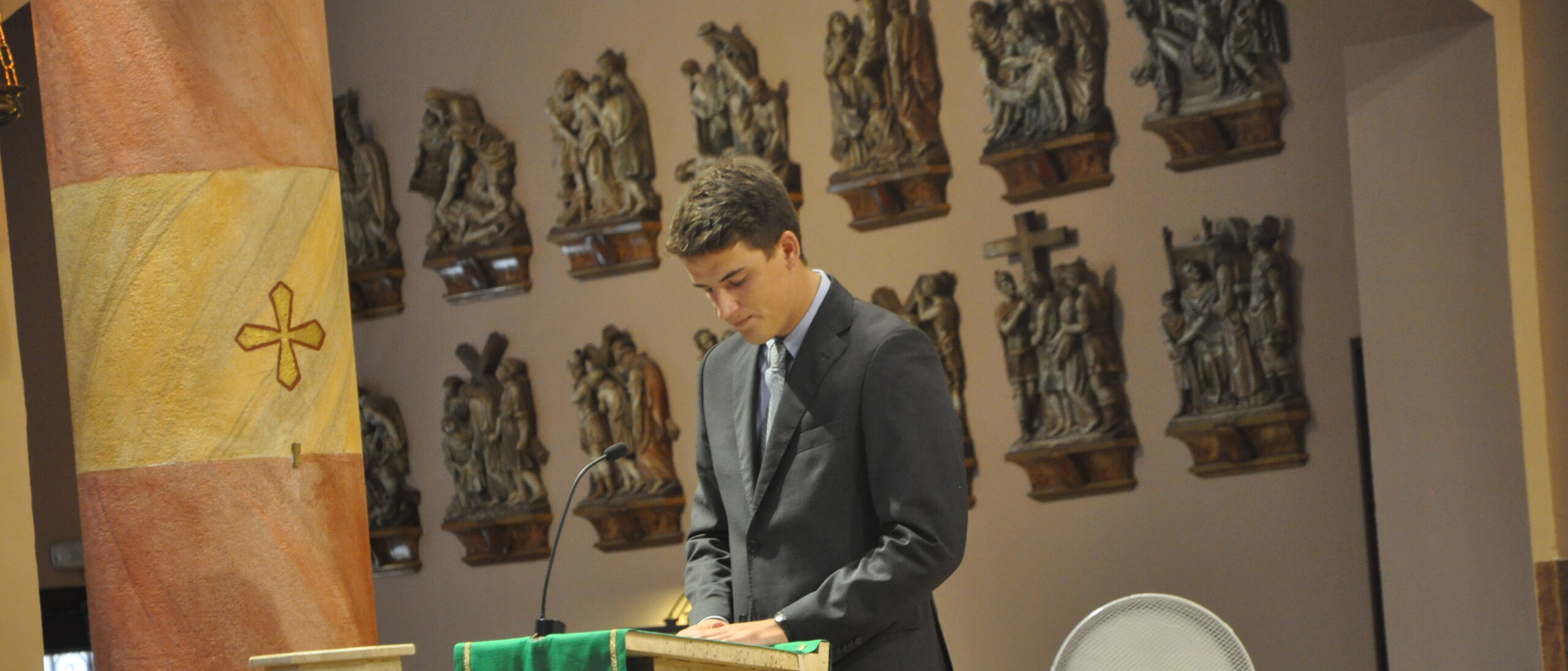
I should like to greet Mn. Yago Gallo, Mn. Pere Montagut and the Association for inviting me to preside at today’s Mass. I also greet Mn. Alex, the parish priest, who has given us the opportunity to celebrate Mass here today. I want to welcome you all, especially those of you who have come from Madrid, who have come to pray together. You come at this moment of communion and hope.
We are in this season of Lent; it is a time of blessing, a time of purification for our hearts. It is also a time to help one another to grow and to walk. Ultimately, this is Christian life itself, and that is why faith is lived in community. Because we all need our brother in order to learn and in order to teach. We all give and we all receive! In short, our fragility makes us open up to the other so that the other may enrich us and, at the same time, with humility and with what we have – however little it may be, like a few loaves or a few fish – we place it at the service of the Lord and also at the service of our brothers and sisters. This season of Lent particularly insists on helping us to grow together and, above all, to purify our hearts. That is why the witness of others is always welcome and, in these days, is perhaps given greater emphasis.
A few weeks ago we held a retreat with 32 young men who are considering the priesthood, and at the end of the retreat each of them was given, on behalf of the vocations and youth secretariats, Marcos’s book, My Story. It is a book that I too have read in these days, as I did not know it. I did know about Marcos’s death. At the time I was a parish priest in the diocese of Terrassa. But of course I heard about the accident and its repercussions, which resonated with many people, not only in Barcelona but also in the neighbouring dioceses.
Had he not died in the accident, I would have met him years later in the History class at the Faculty of Theology, which I was teaching at the time. He too was fond of history and physics. In the end he chose to read Physics, but we would have met in History and I think we would have enjoyed the classes and the lessons together, in which we find so much to learn. It is beautiful that the example, the life, the witness and the journey of others should resonate within us, because this is precisely what makes us grow and helps us. In others we see a sign of the strengths that can inspire us, and sometimes in others we also see – as in ourselves – fragility. This fills us with the sense of being in need, of knowing that in our limitations we are not alone and that together we can always help one another.
Today’s Gospel (Lk 20:9-18), which speaks to us of this beautiful parable, allows us to introduce some elements of Marcos’s life – which may help us in these days – and also what Jesus wishes to show us through the parable. The Gospel is the centre of everything but, as Benedict XVI said in 2006 at a Chrism Mass with some priests of Rome: «How precious and how beautiful is our God, who has made a space for us within himself». And so, in the Gospel there is a space for us. Not only what we receive and welcome into our hearts, but our life too can walk together with the Gospel. God has made a space for us, and the whole of his Word is there to enlighten our hearts and at the same time to welcome us and draw us into this history of salvation.
In this sense, Marcos’s life helps us to discover several things along his journey. The first of these is the affection he received and how fortunate he was in his family and his friends, as well as in the Communion and Liberation movement and in the schools and places where he lived. Looking over his journey as a whole, we can say that – as in every life – there were moments closer to God and moments further from him, especially in adolescence, but above all we see a life surrounded by people who helped him to grow. And this is a gift we give one another when, in the family, among friends, at school, in the parish, in the movements or among priests, we find people who help us, welcome us, love us and teach us. It is then that we gradually build up in our hearts – sometimes rather unconsciously – God’s plan, this vineyard.
The vineyard is the gift God gives us; it is a plan. It is the image of the Kingdom, but also the image of our life. This vineyard which – as the psalm and the prophets remind us – has always been tended and protected, is at times assailed by thieves or by animals. But it is always in God’s heart, in God’s desire and affection. And this is an affection that is made flesh in our personal experience of the Lord, but also in the presence of those around us. To discover this experience of Love in reading this book reminds us that we too need one another in order to live this reality. The love we give one another, the love we share, helps us and leads us to discover God’s love more strongly. And from God’s love we are able to purify our loves, to correct our heart, which, like a disciple, needs to be taught and accompanied. God’s love teaches us to love more and better.
So the first reality is to find in this short but intense life the good fortune and blessing of family, friends, schoolteachers, companions, priests and the movement. The second is to discover how little by little he welcomed into his heart this call of God, which is ultimately sustained by the most fundamental question, which comes first: «What do you want of me, Lord? What is the meaning of my life?»
Marcos took part in various gatherings, outings and pilgrimages with this search in mind. And sometimes he came back from these pilgrimages – especially the first ones, such as Czestochowa – without finding the answer, but always open. There is an experience on the Camino de Santiago, an experience in the Picos de Europa, in Marian shrines, and one still comes back without the answer, yet never stops keeping the question open. The Lord’s vineyard, which is us, is called to grow, and it has its own seasons. It grows according to God’s time. Very often we, caught up in the things of the world and in the world’s rhythms, come before God in a hurry. We come with our legitimate questions, questions that seek a sincere answer and ask for light so as not to go wrong in building the story of our own life and our own home. Yet even so, sometimes the Lord takes his time, or answers little by little, at a different pace. Our haste, into which the world has drawn us, makes us impatient; it even makes us angry if we do not immediately find what we are asking for. The vineyard has its time, which is God’s time, and each one of us has a time, which is God’s time. Not the haste, the urgency or the restless, always immediate violence of the world, but God’s time. It is lovely to find in Marcos’s heart so many people who, little by little, know how to adapt to this time: they ask their questions and await the answers, but always leave the initiative to God. In this season of Lent too we must learn to ask the right questions, but above all to allow and accept that it should be God’s time that gives the answer. People often say «the right person at the right moment». Well, the Lord has for you the right person, the right moment and the right answer, but in his own good time. Sometimes it is hard to understand and accept this. It is beautiful when we accompany one another as Christians, as believers, in accepting God’s time and in never ceasing to keep our heart open in all its questions, awaiting that answer which will enlighten us.
In Marcos we also find this inner struggle, as in so many others. The book describes very beautifully this search to stop being the centre of everything – at times he had centred his life very much on himself – and always to seek the Lord’s desire, to seek what God’s plan is. That is, to become de-centred. It is what he himself quotes here: «in discovering Christ I found man». This de-centring is not always easy and we find it hard. In the vineyard too we find those who seize the vineyard. Sometimes we can fall into the temptation of seizing God’s plan, which is us, of seizing the gift of God that our life has been. The Lord has given us a gift, not so that we may take possession of it but so that we may make it bear fruit. He has given us life so that it may be filled with meaning, but in a dynamic of love and self-giving, not in a dynamic of selfishness and possession. This season of Lent invites us to reflect on this, because at times we want to become the centre, we want everything to revolve around us, everything to fit our needs. When something is not to our liking we push it aside, and when it fits, we welcome it. But we are not prepared to let ourselves be moulded. We need to remember that this vineyard – which deep down is the life of each one of us – has an owner and a lord, who is neither you nor I, but God. The story of these vine-dressers who in the end become murderers because they try to kill the true owner so as to remain themselves as thieves and possessors of what they had received, teaches us this path of de-centring ourselves, of not falling into the temptation of selfishness and possessiveness that turns us into liars. It is the worst thing that could happen to us in our own story: to believe that we, and not God, are the centre of everything. Marcos too goes through his own process, and he does so over the years, but with agility and intensity. Even when he has already understood and taken steps forward, we find this inner restlessness in him. Because in the end this is for a lifetime, and we too must be watchful all our lives. We must not let ourselves be distracted, because as soon as it can, our selfishness slips back in. We must be generous with the Lord and authentic with ourselves. We must recognise who is Lord of all things and place our life at his service. The vineyard is not ours, it is his, and it must bear fruit according to his heart, not according to our interests. That is why it is precious to find in Marcos’s witness this image, which can and should serve as an inspiration to us.
At the same time, in this long process, through the people of the movement, the teachers, the priests, the many friendships – many names appear, and this is a sign of that richness and beauty in his relationship with others, of that generosity and also of the generosity of others – Marcos gradually discovers the face of Christ. And it happens one night at a camp in the Picos de Europa. And it happens too in a kitchen, washing the dishes and talking with a friend. And also in a conversation over Skype. These are moments that he points to as «there I found the Lord», in a gaze, in another’s words. Because God manifests himself through people. They are moments in which he has the person before him, but that gaze belongs to Another, it is the Lord’s. And through their words, through their advice, there he finds that gaze. Even on the first occasion this happens to him, in the Picos de Europa, he says «I don’t remember what we talked about, but there I found that gaze». What stays with him is the encounter. Perhaps the words matter less, but the experience of meeting Christ does. An encounter that still has a long way to go in his story, because this encounter does not mean «here and now everything has changed», but rather «I am still on the way». And such is the Christian life. This Lenten journey too is a sign of our pilgrimage. It is the homo viator, the man who is on the way. This is our vocation: the disciple is a pilgrim. A pilgrim who seeks the face of Christ, a pilgrim who finds it in his brothers and sisters, in the richness of the community, and who discovers it in the intimacy of his heart. The richness of this personal and unique relationship with the Lord. And it is in this encounter that, little by little, he unfolds – not without a certain resistance, as always happens – this vocation to the priesthood. A vocation that finally pushes him to take the step of entering the seminary. And when one lives this idea, when one lives out this self-giving, one does not withdraw from others. Sometimes the priesthood seems to be about renouncing everything, but on the contrary, it is choosing everything for the Lord, in the Lord, through the Lord. Priests, like so many others, have their renunciations each day. We cannot do everything, we choose, but we always choose from within this choice that includes everything, because this Love calls us to everything. And we find in Marcos, and in so many vocations that are arising, how each time we answer yes to the Lord, the more we are given over to others. It is a love that generates self-giving. In the book, Marcos quotes a phrase from Lewis, the author of the Chronicles of Narnia and other books – he quotes it as a word that also helped him at that moment: «when I have learnt to love God better than my earthly dearest, I shall love my earthly dearest better than I do now». And it is true: choosing God does not draw us away; on the contrary, it sends us out with greater authenticity to love more and to love better.
And on this path of inner freedom, on this path of self-giving, we gradually find happiness. This book ends with the words “I am happy”. This is the summary not only of a life but also of a project. This is also what this vineyard should always have been. A vineyard in which there is a project that is our happiness, in which there is a desire of God’s, namely that we should bear fruit according to his heart. In which there is a love that sustains us and cares for us, and even warns us when we lose our way or when we fall into the temptation of selfishness. He sends us his messengers, he sends us even his own Son to help us find the authentic experience of the meaning of our existence, so that this vineyard may bear fruit according to his heart. And when we find this Love, when we welcome it generously, our life is happy.
Let us ask the Lord to help us to make this journey, to make it during this season of Lent, in the season of Easter and every day of our lives. But now, precisely in this time of purification, may we be helped. And also, through the intercession of the saints, those who have gone before us into the Father’s house, with their intercession and help, may we learn each day to love more and to love better, to have this heart open to God’s plan, to be generous in our response. In the end, Marcos left before his time, we might say, seen through the eyes of the years, through the gaze of the world. But at the beginning of the book he tells us that when he was a child and they made up the football teams at school and chose who was going to play, he would be there in the front row so as to be among the first chosen. It is always a sign of preference, that you are good, that we want you with us. Marcos says: “the captain went along choosing, and I wanted to be one of the first”. And in a certain sense the Lord chose him, he chose him for many things but also to go and live with him. Even though at times this hurts our hearts, because there are plans for the future, there are many plans for living here together, but the Lord knows better. We do not understand everything, but we trust. What is certain is that he was, in many senses, one of the chosen, as each and every one of us is. To be aware of being chosen by this Love. And in his case he also chose him to go and live with Him sooner. May it be from this hope too, in the desire to meet again one day in the Father’s house where nothing and no one will ever be able to separate us, that we prepare our hearts to go on living this Eucharist, to welcome, experience and give thanks for the gift of God who gives and gives himself to us so that we may have life.
 Play the video: Homily of Mgr David Abadías on the 9th anniversary
Machine translation. If you spot a mistake, do write to us.